
How Much Does a 20x20 Stamped Concrete Patio Cost in 2026? A Spokane Valley Homeowner's Guide
A 20x20 patio gives you a real 400 square feet of outdoor living space. That's actually a pretty good chunk of room for a dining table, a grill station, and enough seating for your friends and family. So, what's a 20x20 stamped concrete patio going to run you in 2026? Well, that's not a simple number, is it? The final cost really depends on several factors that are super specific to your project and your property right here in Spokane Valley.
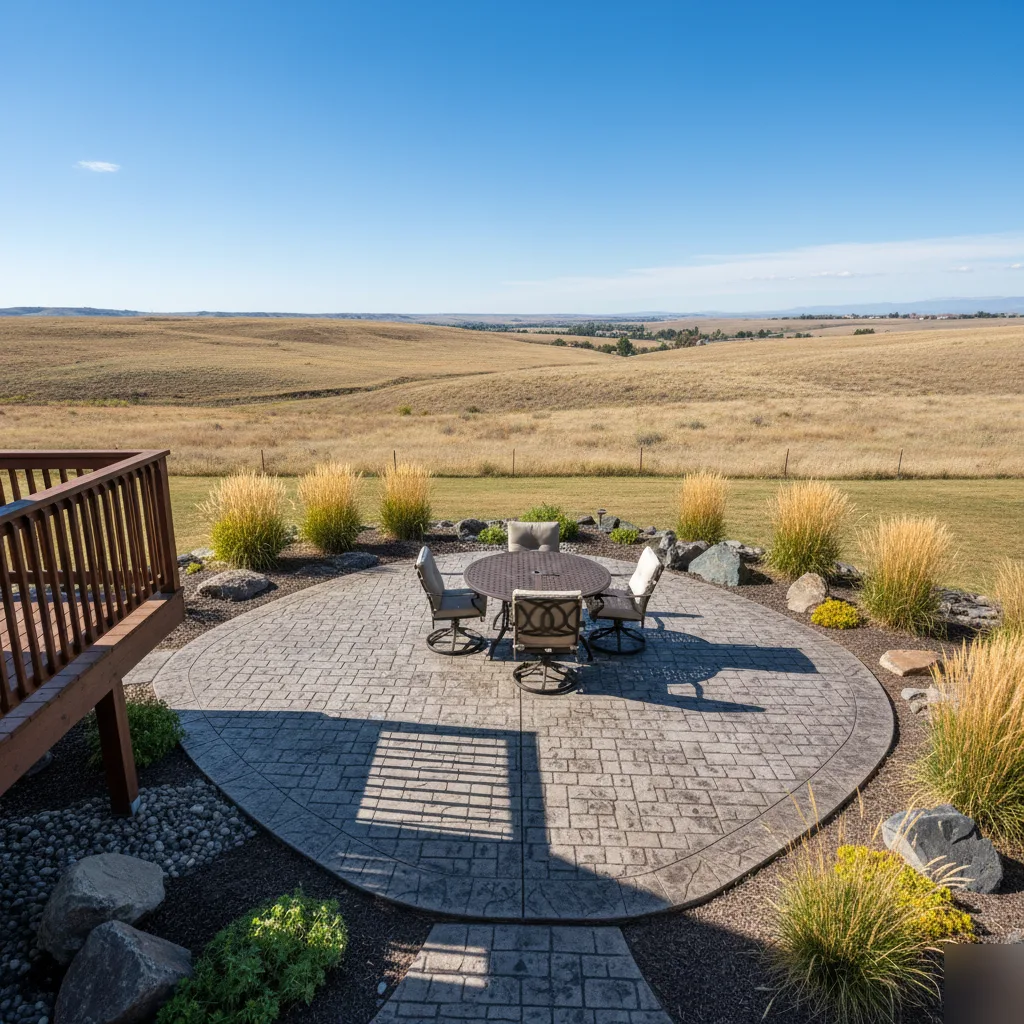
Most homeowners we talk to find that stamped concrete settles somewhere between a basic gray slab and the full investment of natural stone. You're paying for that specific decorative pattern, the color work that makes it pop, and the skilled labor it takes to stamp wet concrete before it decides to set. That whole process is incredibly time-sensitive. It just demands experienced finishers, our crew, who can move quickly, efficiently, and get all those little details exactly right.
The total amount you'll invest really boils down to a few key variables. Square footage, at 400 square feet, is the most obvious one, and that's a very common size for patios around here. But the complexity of the pattern matters just as much, maybe even more. A simple ashlar slate pattern takes far less effort than a multi-colored European fan design, especially if it includes detailed hand-stained accent work. More steps involved, more hours our crew needs to put in, and that shows in the price.
Here’s something a lot of folks don't even think about: site preparation can really shift your budget. If your backyard, maybe near the Spokane River or deeper into the Greenacres area, has a lot of rocky soil (which we see often), the excavation takes longer. Sloped lots always need extra grading work. And if you've got an old, cracked concrete slab that needs to come out first, that demolition adds a whole other layer to the scope of work.
We see this play out all the time with Spokane Valley homeowners, neighbors just down the street from each other. Two houses with identical 400-square-foot patios can end up with really different project totals, simply because one yard was perfectly flat and ready for concrete, while the other needed two feet of fill dirt, a retaining edge, and then some.
Material costs here in 2026 are definitely reflecting the ongoing changes across the concrete industry. The Portland Cement Association has noted that cement and aggregate prices have been on a steady climb lately, thanks to supply chain adjustments and the big increase in demand for residential construction. Those material cost increases, by the way, get passed along to every single project we do.
Color hardener, release agents, and those all-important sealers also factor into the equation. A single-color patio with just an integral color mix uses fewer products than a two-tone design that really goes for those antiquing effects. So the specific look you choose for your patio directly influences what you'll invest.
And then there’s the base work, which we absolutely cannot stress enough. A proper stamped concrete patio in our Spokane Valley climate needs a well-compacted gravel sub-base, usually four to six inches deep. Spokane Valley’s notorious freeze-thaw cycles absolutely demand this kind of preparation. Try to skip the base prep? You'll be looking at cracks, spalling, and real headaches within a couple of winters. We've repaired enough patios that had poor foundations to know for a fact that this step isn't just optional, it’s critical., this is the part most people try to cut corners on, and it always comes back to haunt them.
So, what's the big takeaway here? Your final number truly depends on your specific yard conditions, the exact design you've got in mind, and, of course, the quality of the installation itself. This isn't some off-the-shelf product. It's a custom project, built right on your property, designed for your lifestyle, and built to laugh at Spokane winters.
If you're looking for a clearer picture of what your patio will involve, our stamped concrete patio page breaks down the entire process and helps you understand what to expect before you ever even pick up the phone. You'll notice we pride ourselves on transparency.
Key Factors That Change Your Final Stamped Concrete Price
Look, not all 400-square-foot patios end up costing the same amount. No two yards are truly alike. The final figure really hinges on some genuine decisions you'll make throughout our planning process. our stamped concrete services in Spokane
Some of these factors are pretty obvious, but others, catch people off guard. You can check out our stamped concrete services in Spokane to get a feel for what we do.
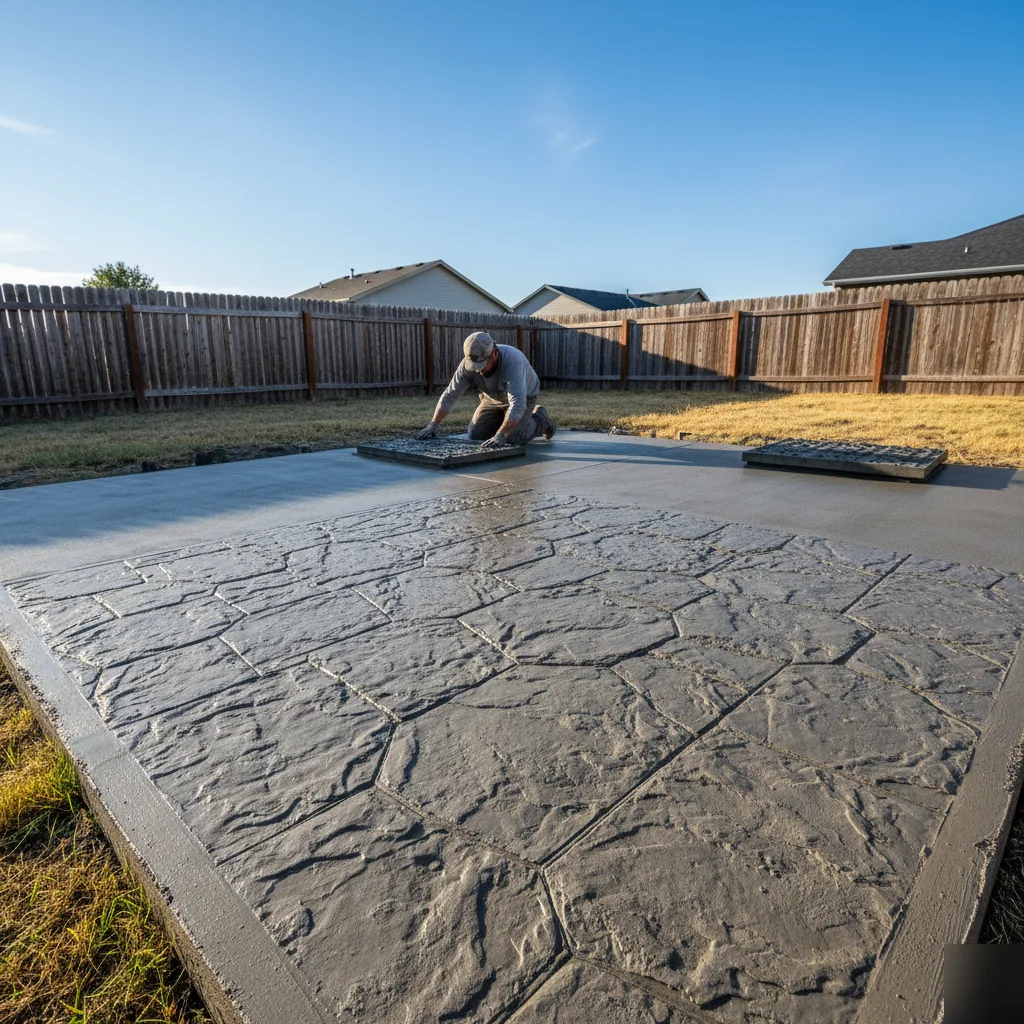
Let's really break down what actually moves the needle on pricing.
Pattern complexity matters more than most people realize. A basic ashlar slate pattern takes less time for our crew to stamp than a detailed cobblestone or a realistic wood plank design. Why? Because intricate patterns demand more precise tool placement, more attention to detail, and much slower finishing work. Our crew just spends more hours on the slab, making sure it’s perfect. And that labor, naturally, adds up fast. We see homeowners in Spokane Valley just fall in love with a European fan pattern in a magazine, then feel a bit surprised when they learn it requires more effort than a simpler stone layout.
Color layers definitely change the scope of work. A single integral color, mixed right into the concrete, is pretty straightforward. But, most stamped patios look their absolute best with at least two tones, maybe even three. An accent release color, for example, gets hand-broadcast across the surface just before stamping. Some designs call for three or even four distinct color applications. Each additional layer means more material, more careful application, and a higher level of finishing skill. So, if you're dreaming of that rich, natural stone look with real depth and variation, expect the color work to definitely influence your total investment.
Site access is one of those truly hidden factors, one you don’t think about until the truck pulls up. Can a concrete truck back right up to where your patio will be? Or does our crew need to wheelbarrow every single load around the side of your house, through a narrow gate, or across a long distance? Homes near the Spokane River, or in some of the older neighborhoods along Dishman-Mica Road, sometimes have really tight lot lines or steeply sloped yards. Difficult access doesn't just slow things down a bit. It can require additional labor, extra equipment, or even the use of a concrete pump – which is an added cost.
Ground preparation is another huge one, truly. Most people just don't realize how important it is until it's too late. If your existing soil is really soft, full of old tree roots, or just poorly graded, the base work will take longer. A solid patio, especially one built to withstand our Spokane Valley winters, needs a properly compacted gravel sub-base, typically four to six inches deep – that's according to the American Concrete Institute, by the way. Skip this critical step, and you’re basically asking for cracks and heaving within a couple of years, which we see happen all too often. The condition of your ground before any concrete is ever poured plays a direct and massive role in the overall project scope.
Thickness and reinforcement are absolutely not optional choices for us. A standard residential patio slab generally runs about four inches thick, usually with wire mesh or rebar reinforcement. But what if you plan to put a heavy hot tub on it? Or roll a big, heavy grill station across it regularly? Heavier loads demand thicker concrete and stronger reinforcement. And that, of course, means more material. We won't cut corners here.
Here’s something worth knowing. The actual shape of your patio affects things too. A perfect 20x20 square is the most efficient layout for our crew to form and pour. Curves, sharp angles, or intricate cutouts around existing landscaping beds require custom formwork. And custom forms simply take more time to build, measure, and set. A rectangular patio with just one rounded edge might seem like a small design choice, but it absolutely changes the labor involved for our guys.
Borders and decorative bands also factor in. A contrasting border pattern around the perimeter creates a really finished, professional look. But it requires a second, distinct stamping process within the same pour. Our crew has to manage two different patterns and often two different color schemes simultaneously before the concrete starts to set. That's highly skilled, time-sensitive work, requiring serious focus.
If you're trying to wrap your head around how all these factors come together for your specific backyard, take a look at our stamped concrete services in Spokane for a clearer picture of what's involved. Every single project is a little different, and truly knowing these variables upfront puts you in a much stronger position when you're ready to move forward with your dream patio.
Popular Stamped Concrete Patterns and How They Affect Cost
Not all stamp patterns require the same amount of work, you know? That's the part most homeowners tend to miss. The pattern you ultimately pick directly changes how long our crew needs to be on-site, how many different stamps they'll use, and how much intricate detail goes into the final finishing. All of that, every single piece, shifts what you’ll eventually pay for your project.
Let's go ahead and break down the most common options we pour right here in Spokane Valley.
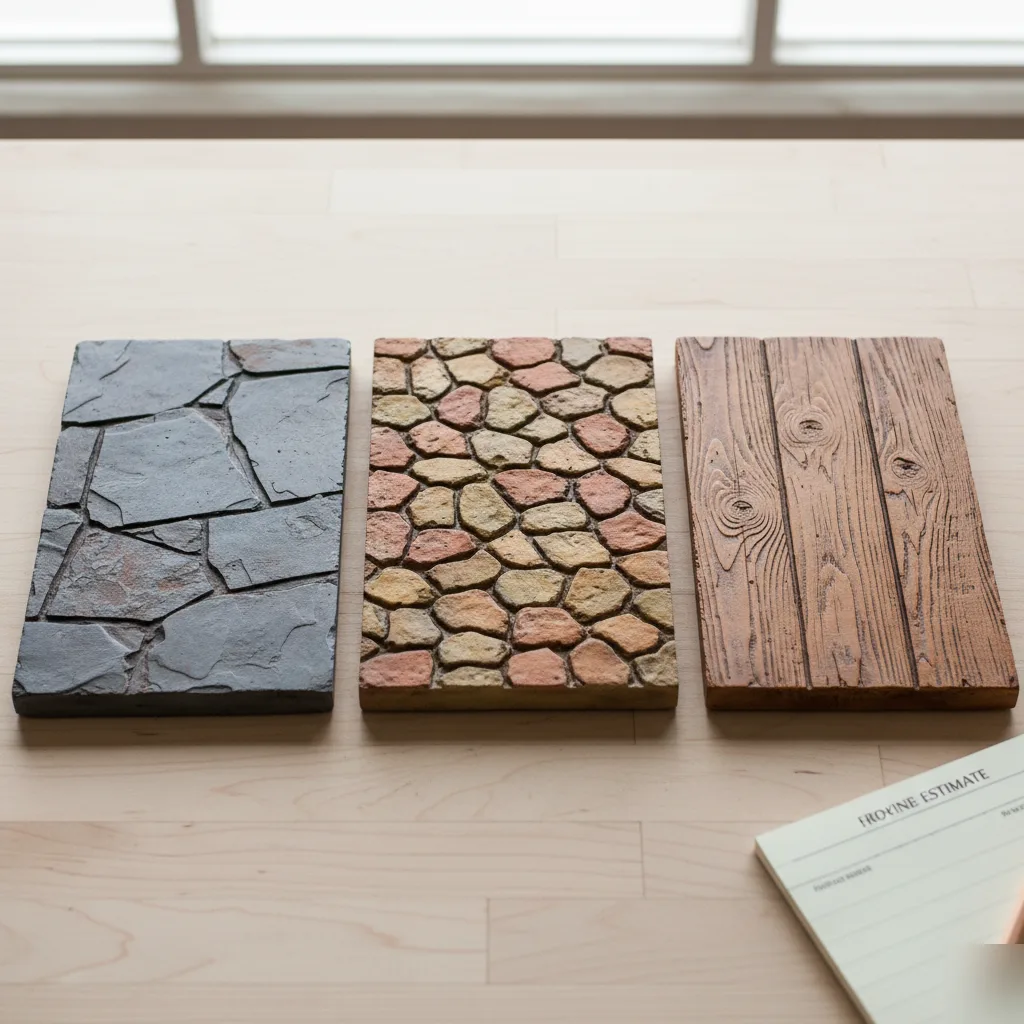
Ashlar slate is probably the most popular choice we see, year after year. It really mimics cut stone, with those nice clean lines and a repeating rectangular layout. Because the pattern is quite uniform, it's generally faster to stamp and a lot easier to keep consistent across a full 400-square-foot slab. That makes it one of the more budget-friendly options, for sure. If you want a classic, elegant look without a lot of extra fuss or expense, ashlar slate delivers beautifully.
Wood plank patterns have absolutely exploded in popularity over the last few years. They give you all the warmth and appeal of a classic wood deck, but without the splinters, the rot, or the annual sealing headaches that wood always seems to bring. But here’s the thing about them. Wood plank stamps require really careful, sometimes even hand-detailing to make the grain look genuinely realistic. Each individual "board" needs precise attention. So the labor time for our crew naturally goes up compared to a basic slate layout, and that impacts the cost.
Then there's cobblestone. Oh, it’s gorgeous, with that authentic, old-world feel. It's truly perfect for a backyard entertaining space, maybe near the Centennial Trail, or really anywhere you want that classic European courtyard vibe. But cobblestone patterns have tons of small, often irregular shapes. Every single joint line needs to look just right, exactly where it should be. We consistently see our crews spend noticeably more time on cobblestone patterns than on larger-format designs. More time for us, of course, means more labor cost on your project.
Flagstone sits somewhere right in the middle. The shapes are wonderfully organic and give that random, natural-looking feel, which actually makes small imperfections much less noticeable. A skilled crew, like ours, can move through flagstone at a pretty reasonable pace. It’s quite forgiving, you know? And it just looks so natural next to garden beds and all sorts of landscaping, which is why so many Spokane Valley homeowners really gravitate toward it for their backyard patios.
So, what really drives the cost difference between these various patterns? It’s three main things, really.
First, it's all about stamp complexity. Patterns with lots of tiny details or very irregular shapes simply take longer for our crew to press, carefully touch up, and properly finish. Second, you've got color layers. Some patterns just look their best with two or three colors blended together to create real depth. A simple, seamless slate might only need one base color and a release agent. But a truly realistic cobblestone might need an integral color, a contrasting release, plus some hand-applied accent staining after the pour. Each additional color step, naturally, adds both materials and time to the process. Third, and this is a big one, there's border work. Many homeowners really want a contrasting border stamp around the patio edge, and that truly creates a finished, polished look. But that's a second pattern that our crew has to lay, align, and color separately. It’s more steps.
Most people don't quite realize this until we're deep into the discussion: choosing a really complex pattern and then adding a separate, decorative border can easily push your project into a completely different cost tier. It's not just a small bump in price. We always recommend picking your main pattern first, then deciding on those beautiful extras like borders and multi-tone coloring based on your overall budget. We want you to be thrilled with the final look and the investment.
Here’s a real scenario we had just last spring. A family over in the Greenacres area really wanted a herringbone brick pattern with a soldier course border and three distinct accent colors. It was a beautiful design, no doubt about it. But when we walked them through what that actually involved, they quickly realized that a two-tone ashlar slate with a simple broom-finished border gave them about 90% of the look they loved, but at a much more comfortable investment level. They were absolutely thrilled with the end result, and, that's what matters most to us.
If you're trying to figure out which pattern makes the most sense for your space and your budget, our stamped concrete patio page walks through all the options we install most often right here in this Spokane Valley area. It's always a good starting point before you even think about requesting an estimate. We want you informed.
Bottom line: the pattern isn't just a style choice, friend. It’s a very real cost decision. Pick the one that truly matches both your personal taste and your practical reality.
Frequently Asked Questions About Driveway Resurfacing
How long does a resurfaced driveway actually last in Spokane Valley?
A resurfaced driveway in Spokane Valley typically lasts 8 to 15 years, sometimes longer. The exact lifespan depends on the material used and how well the job was done. Asphalt overlays usually last 8 to 12 years. Concrete resurfacing can go 10 to 15 years or more. Spokane Valley's freeze-thaw cycles do add stress, but a properly prepped surface handles that well.
How does Spokane Valley's climate affect how long a resurfaced driveway lasts?
Spokane Valley's climate is hard on driveways. Summer temps push past 90°F and winter lows drop well below 20°F. That constant expansion and contraction wears on any surface. The freeze-thaw cycle is the biggest threat. Water gets into tiny cracks, freezes, expands by about 9 percent, and forces those cracks wider. Homeowners near the Spokane River or in low-lying areas see this damage every spring. Choosing the right material and sealing regularly helps your resurfaced driveway hold up through those swings.
Which resurfacing material lasts the longest?
Paver overlay systems last the longest — often 15 to 25 years. They spread weight across individual pieces and allow easy spot repairs. Concrete resurfacing comes in second at 10 to 15 years or more. Asphalt overlays typically last 8 to 12 years but handle freeze-thaw cycles better due to their flexibility. The best material for you depends on your driveway's current condition, how much traffic it gets, and what Spokane Valley weather will throw at it each season.
Is resurfacing just a temporary fix that won't last?
That's one of the most common misconceptions we hear. Resurfacing is not a patch job. It adds a full new wear layer on top of a solid base. Done right, it can last a decade or more. The key word is 'done right.' Proper crack filling, bonding agents, and correct overlay thickness all matter. A rushed job with no prep work will fail fast. A quality resurfacing job is a real, long-term solution — not a bandage.
When should I call a professional instead of trying to resurface my driveway myself?
Call a professional if your driveway has widespread cracking, drainage problems, or a base that feels soft or uneven. DIY resurfacing kits work for very small surface repairs. But anything beyond a minor crack needs proper prep — cleaning, crack filling, bonding agents, and correct overlay thickness. Getting any of those steps wrong shortens the lifespan dramatically. If you're seeing spider-web cracking across a large area, like many driveways near Sullivan Road, a pro assessment is the smart first step.
Does sealing a resurfaced driveway actually make it last longer?
Yes, sealing makes a real difference. Concrete overlays need sealing every few years to block moisture from seeping in. According to the Portland Cement Association, a well-maintained concrete surface can exceed its expected service life by 50 percent or more. Sealing prevents water from reaching micro-cracks before they become big ones. In Spokane Valley, where wet winters and hard freezes are normal, skipping the sealer shortens your driveway's life faster than almost anything else you could do wrong.
Ready to Experience the Concrete Revival Difference?
Complete Service Area Coverage
- Spokane and Spokane Valley
- Coeur d'Alene metro area
- Deer Park and Newport
- Liberty Lake and Otis Orchards
- Cheney and Medical Lake
- Post Falls and Rathdrum