Average Cost to Resurface a Concrete Driveway in 2026: What Spokane Valley Homeowners Need to Know
What Concrete Driveway Resurfacing Actually Includes
Most homeowners in Spokane Valley picture a simple coat of something spread over their old driveway. That's not how it works. Resurfacing is a multi-step process, and understanding what's involved helps you make sense of the average cost to resurface a concrete driveway in 2026.
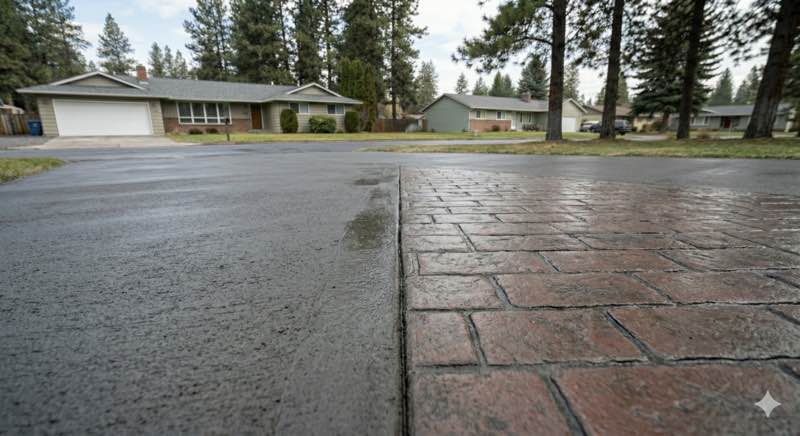
Here's the real breakdown.
First comes the prep work. This is where most of the labor goes. Your existing concrete gets pressure washed to strip away dirt, oil stains, and loose material. Cracks wider than a hairline get routed out and filled with a flexible repair compound. Spalling or flaking spots get chipped back to solid concrete. We see homeowners skip this step when they try DIY, and the overlay peels off within a year. Every single time.
After cleaning and crack repair, a bonding agent goes down. Think of it like primer before paint. This liquid layer creates a chemical grip between your old slab and the new surface material. Without it, the fresh overlay has nothing to hold onto. And Spokane Valley's freeze-thaw cycles will punish a weak bond fast — which is exactly why driveway resurfacing in Spokane demands more prep than it might in milder climates.
Then the actual resurfacing layer gets applied. This is a Portland cement-based overlay, typically between one-eighth and three-eighths of an inch thick. It's not regular concrete you'd pour for a new slab. It's a specially engineered mix designed to bond tightly and resist cracking at thin depths. Some projects use a polymer-modified overlay for extra flexibility, which matters in our climate where temperatures swing from single digits to ninety degrees across the year.
But what about the finish? You've got options here. A basic broom finish gives you a clean, slip-resistant texture. Stamped or stenciled patterns can mimic stone, brick, or tile. Decorative finishes add steps and time to the project, which affects the final number on your estimate. Most driveways along the Appleway corridor and throughout the Valley use a standard broom or knockdown texture because it handles snow removal well.
So what doesn't resurfacing include? It won't fix a slab that's sinking, heaving, or broken into large shifting pieces. If your driveway has sections that have dropped an inch or more, that's a structural problem. Resurfacing only works when the base underneath is still stable. A good contractor will tell you this upfront during an inspection. Most people don't realize this until it's too late, and they've already paid for an overlay that cracks within months.
The whole process typically takes one to two days for an average two-car driveway. Day one covers prep, repairs, and bonding. Day two is the overlay application and finishing. Curing time adds another 24 to 48 hours before you can drive on it, depending on weather conditions.
One thing worth mentioning: the condition of your existing concrete directly controls how much prep labor is needed. A driveway with dozens of cracks, heavy staining from vehicle fluids, or widespread surface deterioration requires more time before any resurfacing material goes down. A relatively clean slab with minor cracking? That's a straightforward job.
If you're curious how your driveway's current condition affects what you'd actually pay, our concrete driveway resurfacing page walks through the process we follow for Spokane Valley homes and what to expect at each stage.
Key Factors That Determine Your Resurfacing Cost in 2026
Not every driveway costs the same to resurface. That probably doesn't surprise you. But what might surprise you is just how much the final number can swing based on a handful of specific details. Let's break down the big ones so you know exactly what's driving your estimate.
Driveway size and shape. This one's obvious but worth saying clearly. A 400-square-foot driveway and an 800-square-foot driveway aren't just different in size. They're different in material volume, labor hours, and prep time. Odd shapes matter too. L-shaped driveways or ones that curve around a garage take more effort to form and finish than a simple rectangle. We see this a lot in Spokane Valley neighborhoods like Greenacres and Ponderosa, where homes built in the 1970s and 1980s often have wider, angled driveways that add complexity.
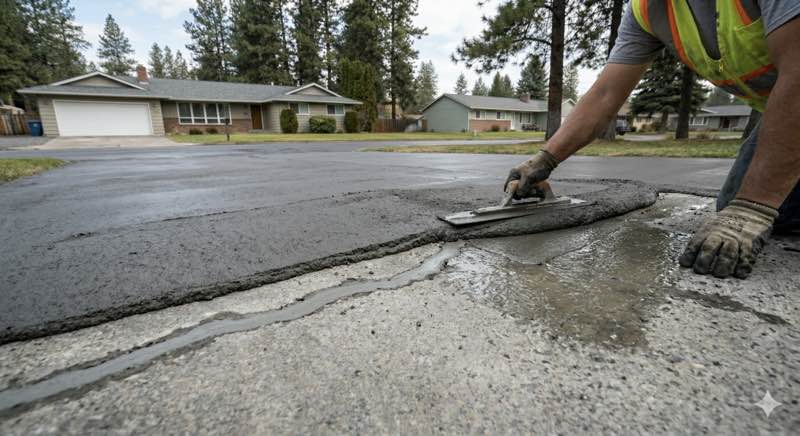
Current condition of the slab. Here's something most people don't realize until it's too late. If your existing concrete has deep cracks, heaving, or major settling, a simple overlay won't cut it. The crew has to do more prep work. Sometimes that means grinding down high spots, filling voids, or even removing and replacing damaged sections before the new surface goes on.
A driveway with just surface wear and minor hairline cracks? That's a straightforward job. One with tree root damage or frost heave? Totally different scope.
Overlay material and finish type. A basic concrete resurfacing coat is the most affordable option. But maybe you want a stamped pattern, an exposed aggregate look, or a decorative stain. Each of those adds steps to the process. Stamping requires specialized tools and more skilled labor. Staining adds a separate application phase. The finish you choose has a real impact on your total cost, and it's one of the areas where you have the most control over your budget.
So what finish actually makes sense for your home? That depends on your goals. If you're just fixing up a cracked surface for daily use, a standard overlay works great. If you're boosting curb appeal before selling, a decorative finish might be worth the investment.
Access and site conditions. Can a concrete truck back right up to your driveway? Or does the crew need to wheelbarrow material from the street? Tight access adds labor time. Sloped lots, landscaping in the way, or driveways tucked behind fences all affect how efficiently the work gets done. We've worked on properties along the Spokane River corridor where access alone added significant time to the project.
Time of year. Concrete work in Spokane Valley is seasonal. Our freeze-thaw cycles mean most resurfacing happens between late spring and early fall. Booking during peak summer months can affect scheduling and availability. And if temperatures drop below 50 degrees during curing, the material won't bond properly. According to the Portland Cement Association, proper curing temperature is one of the most critical factors in overlay longevity.
Labor and material costs in 2026. Material prices have shifted over the past few years due to supply chain changes. Labor costs have also risen as demand for skilled concrete finishers stays high across the Inland Northwest. These aren't factors you can control, but they're worth understanding when you're comparing estimates.
The bottom line? Your specific cost depends on your specific driveway. A neighbor down the street might pay a very different amount for what looks like the same job. If you want a clear picture of what your project involves, visit our concrete driveway resurfacing page to request a personalized assessment.
Typical Price Ranges for Concrete Driveway Resurfacing in 2026
Let's get right to the numbers. Most homeowners in Spokane Valley can expect to pay somewhere between three and eight dollars per square foot for a standard concrete driveway resurfacing job. That's the ballpark. But "standard" does a lot of heavy lifting in that sentence, so let's break it down.
A basic resurfacing with a plain concrete overlay on a driveway that's in decent shape? That sits at the lower end. You're looking at roughly three to five dollars per square foot. This usually covers surface prep, a thin cementitious overlay, and a basic seal coat. Nothing fancy, but it gets the job done and makes your driveway look new again.
Now bump that up to a decorative finish. Stamped patterns, integral color, or exposed aggregate push costs toward five to eight dollars per square foot. Sometimes higher. The material itself costs more, and the labor takes longer because the crew needs to work with the overlay before it sets. We see a lot of homeowners in the Greenacres and Dishman areas choose a simple broom finish with a single color tint. It's a sweet spot between looks and budget.
So what does that mean for a real driveway? The average two-car driveway runs about 400 to 600 square feet. Quick math puts a basic resurfacing job somewhere between $1,200 and $3,000 for most homes. Decorative options can push a 600-square-foot driveway closer to $4,800. These aren't exact quotes. They're ranges based on what the industry is seeing heading into 2026, according to data from HomeAdvisor's cost guides.
Here's something most people don't realize until they get their estimate. The condition of your existing slab changes everything.
If your driveway has minor surface cracks and some spalling, prep work stays minimal. But significant cracking, heaving, or settling means the crew has to do more repair work before any overlay goes down. Crack filling, leveling compounds, and extra grinding can add one to three dollars per square foot on top of the base price. A driveway that looks like it just needs a facelift might actually need surgery first.
Spokane Valley's freeze-thaw cycles are brutal on concrete. I can't tell you how many driveways I've looked at near Sullivan Road where the surface seemed fine from the street, but up close, the scaling told a different story. That winter damage adds prep time and cost.
Thickness matters too. A thin microtopping overlay costs less than a full half-inch polymer-modified overlay. But the thinner option won't work on every driveway. If there's significant surface damage, you need the thicker application, and that means more material.
And don't forget access. Driveways on slopes, driveways with tight access for equipment, or driveways connected to other concrete work like walkways and patios can all affect what you'll pay. A straightforward flat driveway next to an open yard is the easiest scenario. Anything more complicated adds labor hours.
One more thing worth mentioning. Material costs have been climbing steadily since 2023. Portland cement prices rose roughly eight percent year over year according to the U.S. Bureau of Labor Statistics Producer Price Index. That increase trickles down into every resurfacing estimate you'll see in 2026. It's not dramatic, but it's real, and it's one reason getting an estimate sooner rather than later makes sense.
If you're trying to figure out where your specific driveway falls in these ranges, the best move is to get a professional assessment. Our concrete driveway resurfacing page explains what we look at during an evaluation and how to get started.
Frequently Asked Questions About Driveway Resurfacing
How do I know if my Spokane Valley driveway needs resurfacing or full replacement?
Look at the cracks and check for any sinking or heaving. If you see hairline cracks, surface pitting, or fading, resurfacing is likely the right call. But if slabs have sunk, cracks go all the way through, or sections have broken apart, the base has probably failed. That means replacement. Spokane Valley's freeze-thaw winters speed up both types of damage, so catching it early matters. Our driveway services page walks through exactly what to look for.
Is it a mistake to resurface a driveway that really needs replacement?
Yes, and it happens more than you'd think. Resurfacing over a failed base is one of the most common mistakes homeowners make. The new layer looks great for a few weeks, then the same cracks and low spots come right back. You end up paying twice. If your driveway has deep structural cracks, sunken sections, or soft spots underneath, replacement is the only fix that will actually hold.
Can a driveway near Greenacres or along Sprague Avenue be resurfaced even if it's 15 years old?
Age alone doesn't decide it. A 15-year-old driveway with surface wear but a solid base is still a strong resurfacing candidate. Many driveways in the Greenacres and Sprague Avenue areas that were poured in the early 2000s fall into this category. The surface looks rough from years of freeze-thaw wear, but the foundation is still intact. What matters most is the condition of the base, not the number of years on the driveway.
Does Spokane Valley's climate affect how long a resurfaced driveway lasts?
Yes, it does. Spokane Valley gets hard freeze-thaw cycles every winter. Water gets into small cracks, freezes, expands, and makes those cracks bigger. According to the Portland Cement Association, repeated freeze-thaw exposure is a leading cause of concrete surface wear in northern climates. A properly bonded resurface layer holds up well here. But if the base has already shifted from years of this cycle, no top layer will stay put for long.
When should I call a professional instead of trying to fix my driveway myself?
Call a professional when you're not sure what's causing the damage. Surface cracks and minor spalling look simple, but the real issue might be underneath. A failed sub-base, tree root damage, or poor drainage won't show up until you dig in. Getting a professional assessment saves you from guessing wrong. If you pick the wrong fix, you waste money on a solution that won't last.
What's the easiest way to test if my driveway base is still good?
Walk your driveway slowly after it rains and watch where water pools. Small puddles in one spot can often be corrected during resurfacing with a slight grade fix. But standing water across several sections usually means the base has settled in multiple places. That points toward replacement. You can also press on any cracked areas with your foot. If the surface flexes or feels soft, the base underneath has likely broken down.
Ready to Experience the Concrete Revival Difference?
Complete Service Area Coverage
- Spokane and Spokane Valley
- Coeur d'Alene metro area
- Deer Park and Newport
- Liberty Lake and Otis Orchards
- Cheney and Medical Lake
- Post Falls and Rathdrum